
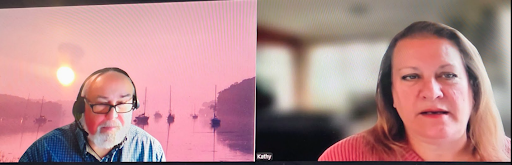
Jack: I wanted to start by asking about the company name, Together and Caring. Could you talk about how that name represents the mission of the company?
Kathy: Yes, I would love to. So, when we were coming up with our name, that one key word really was so important to us, and we went through a few iterations, but we came down and agreed on Together and Caring because we looked at what is it that we’re trying to accomplish, and how are we going to go about doing that. And Together just represents all of what we do. We work together with the client, we work together with the families, we work together with our community partners. We’re often working in concert with hospital discharge planners and the administrators of senior living and things like that. And it’s the whole idea that that collaboration has to happen. No one person can do this and get successful outcomes for our older adults. So, I think it really embodies what we’re trying to do, and it really is a great representation of how our work happens, how it manifests in the community.
Jack: What about the caring part? What does caring mean? We use that word all the time “I really care,” or “You don’t care.” What is this second part of the title of the company, caring, mean to you and mean to your organization?
Kathy: I do think it’s equally important, and I think for us, the caring piece means that we are present, that not only do we have that love for older adults and the passion individually, it’s that we’ve committed to this. So, together and caring means we’ve committed to providing the service, that we’ve committed to this higher level, this standard of care that means that we don’t give up when it gets hard, that we don’t accept the limitations that are out there, that we move beyond it. And so that’s what it means to our team. So that is also very complex, because sometimes the caring goes beyond just our client, but it also involves being very empathetic to other players in the market, and the difficulties that they face, hospital staff, the pressure to get people out the door and out of beds, because 200 other people are waiting for that bed. So the caring goes beyond just to our clients, it goes to all the people who were involved in that together moment.
Jack: I think that really explains in a very practical way, what we mean in the sixth level by ethic of care. I think that describes it really beautifully – the presence, and love and passion, and commitment. So thank you for that very much.
Jack: I’m really interested in what you look for in a new hire. Given this framework, this set of principles, you have to find people to hire and you’re asking them to embrace something that is really very, very difficult. It’s not difficult in saying so, but it’s very difficult in execution. It requires enormous stamina, both physical and emotional. So, what do you look for in a new hire?
Kathy: So, we are very, very intentional in our hiring, And I will say, and it’s not from a point of bragging, it’s honestly so humbling and, and just so fulfilling. At this point, we have people coming to us asking to work for us. And I think that’s because the word spreads. If you feel great about where you work the word spreads.
What I look for in a new hire, is whether or not they’re going to fit into our culture. Truly, that’s the most important piece for me, and by fitting into our culture, I mean, do they share our passion? Are they accepting of our business model, and our business model goes with trust first? We have to be able to trust each other. Are they willing to be in an environment where they’re valued, but also that they’re held accountable?
A lot of people are used to being at jobs where they’re told what to do, and then they’re really good at getting those things done. And that… that’s not the way we work here. So someone has to have that intrinsic motivation. They have to be able to want to solve problems, and they want to help people get through these really difficult times. There’s a lot of passionate people out there, and that piece of it is not hard to find, honestly. There are a lot of people who care deeply and just are caught up in roles where they can’t really express that very well. So as long as they have that passion, they understand our environment, they’re willing to be their own boss at times, but also be a very valued member of the team, that they want to contribute, their opinions, their thoughts, their dreams,
I don’t know if that’s very clear. That sounds like someone who might be almost a unicorn, but honestly, those people exist. They’ve just been caught up in jobs where they couldn’t shine in the way that they needed to, so it’s tough to find new people, but again, like I said, we’re very intentional, and if I think that they are somebody who does better in a structured environment, I’ll be very honest with them, because it’s not going to be helpful to either one of us if… if they come on board and then… and then feel like they’re being swallowed up with the enormity of what’s out there for them managing these clients.
Jack: How do you onboard them? In other words, now we’re talking about leadership and management, right? How do you make sure that you are bringing them into the organizational culture? And then, how do you frame and enact accountability?
Kathy: Okay, so when they come on board, obviously there’s the practical training of systems and products and things like that, but what we do is we do shadowing. It’s impossible to understand how you need to engage with clients unless you can see that modeled. So that’s typically what we do. We even do it across our locations. So someone from Syracuse might come here, and model and shadow with, care managers in Rochester, and someone in Albany might do the same in Syracuse. So we very much want them to see different approaches, different perspectives. They would definitely sit with a social worker who’s managing cases, and then they would also sit with a nurse, regardless of who they are, so that they can get those different perspectives. We talk a lot about the identity statement when they start, we talk about what that means, what the expectations are.
And then as far as accountability, I talk with our care managers every week. I have a call with everybody, and we talk through cases, and if there’s something that is missing, if, they’re frustrated by maybe a family dynamic that they’re struggling with, that’s when we have the opportunity to talk about what it means to be present for that family, and how we accept and honor perspectives that have histories behind them that we can’t possibly know, right? So we have to just accept where things are right now, and then… and help them move forward. We also have accountability with each other. So, at our team meetings, we talk about, things that we have set as expectations for us to do out in the community, and so people have to be accountable for how they’ve participated, what they’ve done. So those are the main ways that we just make sure people feel like they understand where they fit and how they’re able to show up for us as a team.
Jack: That’s a wonderful thing. That’s really great, and it demonstrates great leadership and really effective management. As an aside, where are the guys?
We make an argument in The Sixth Level that essentially guys are socialized out of empathy, out of what you’re calling that passion and commitment and so on, right, to externalities like making money, and to achieving prestige and status and so on and so forth. It really struck me — where are the guys?
Kathy: I know, it’s a very good question. I don’t know that I have, a great answer for you, Jack, because we just aren’t getting people, we aren’t getting males who are interested in the work. We don’t get them as applicants. We don’t have people asking us questions about what would it be like to work for you, where we interact with a lot of women who do ask that question. So it may be that our societal, assignment of the caring, the nurturing, the being patient, all of that should be with women. And I agree 100%, it doesn’t need to be, but I do think that in the conversations I have had with males about the roles that we play as care managers, they’re overwhelmed by it. Overwhelmed by the idea of it. Just say, for instance, you have a client who’s very obstinate and not cooperative, and if I speak to a gentleman about the situation, they’ll say, I don’t know what you do. I don’t know how you would even manage this. They’re just… they’re not agreeable, and it’s hard for them to move beyond that to understand what’s the reasoning behind it. Are they fearful of losing control? Why are they putting up these walls? And so maybe it’s that step that’s hard, for men to take. I’m not sure. I don’t know that I have a great answer, but we just don’t get the interest.
Jack: What about on the nursing side? You see men, male nurses in hospitals, and they’re taking caretaking roles there, so you would think that you might get men applying for the nursing side of the tasks.
Kathy: I agree. I will say, though, that our nurse care managers will be the first ones to tell you that nursing care in a hospital, although I don’t mean to make it sound cold, a lot of it is transactional, and some of the male nurses are wonderful with their patients, but their patient is there. They’re there for a short time, and it’s transitory, and getting somebody’s blood pressure, doing their vitals, doing all those things that have to get done, whereas the care managers often just, even the nurses, need to just sit, they need to sit, they need to understand the situation, they need to actively listen, and it’s a very different environment.
Jack: So, before I turn to the Sixth Level specifically, one more question about management. This job clearly requires resilience, requires a certain amount of emotional range, and requires a lot of giving. You’ll have to tell me about what the reciprocity is in a lot of these situations with elder care. But how do you manage morale? How do you manage to keep people intrinsically motivated? How do you manage to mitigate stress?
Kathy: I will say that for most of our care managers, a lot of that expression of frustration or the need for the support or the validation happens during those weekly calls that I had mentioned. It’s my opportunity to make sure they’re okay. We also do discussions during team meetings about, if I know of a case that’s really causing a lot of stress, we will address that. We’ll do some peer coaching during our weekly meetings, so that the person has some new ideas about approach, that they feel supported. A lot of times, we just need to know that we’re not the only one, that other people have gone through this, and so having that team support is also really helpful.
And then, honestly, if I am gauging someone to be getting close to burnout, then I will encourage them, please take a day tomorrow, please shorten your day on Monday, or why don’t you skip the meeting? I think you really need a rest, and especially when we lose clients, I can tell you that’s sometimes the really the hardest part, because we may have been with them for a year, or maybe even just 6 months, and they become family to us. So, those losses are hard, and I definitely give people space and the team gives support. Certainly, physical expressions, whether it’s making a donation to that person’s charity that they’ve named in their obituary, just showing them that we really do care. We care about the time and emotion that they’ve invested in those cases.
Jack: I can’t imagine the emotional endurance that your staff needs to have. It is really pretty extraordinary.
I was taken that you reached out to me regarding The Sixth Level, and so I was fascinated with how that happened. How does The Sixth Level speak to you, and how does it resonate for you? You are clearly, from my point of view, a sixth-level leader.
Kathy: Thank you. Well, I’m always curious, I love to learn about business strategy and things like that, so when I saw The Sixth Level in your email signature, I’m like, oh, what is this? Sounds so intriguing. And then I went to the website and started reading through some of your research and your mission, and there’s a statement on there, and I immediately called over one of my Care Managers who happened to be there, and I’m like, read this! And she said to me, “that sounds like us.” And I said, “I know, isn’t this incredible?” And I immediately, that day, ordered your book, and I read through it. And then I was just so grateful that you were willing to speak to our team at our annual meeting. But the reason why it spoke to me, and I’ll be very honest with you, Jack, I spent my whole career before this role, never being in a position where I felt like people understood how much value women bring to the table, and how short-sighted we are in allowing women, not being flexible to allow women to continue to participate when they’re raising their children.
We can say how progressive we are, and maybe now, since COVID, with a lot of the remote work, it is better. But I can tell you, it was never easy for me raising 3 kids, being married, having a house to run, and being able to have my career without that guilt.
And so that’s something we really honor in our environment here. Everybody’s an adult. I do not check people’s schedules. If they’re doing the work, that’s all that matters to me. I want them to be present to feel good as a mom. It’s really hard as a woman to feel like you’re being a good mom, and you’re being quote-unquote selfish and having a career. So that’s why it spoke to me, because I felt like, wow, somebody gets this. They understand how valuable a woman’s perspective can be in leadership and in… in work, and quite honestly, especially in the work that we do.
Jack: The great irony, of course, is during COVID, it was women who had to drop out of the public workforce to essentially do the daycare and the childcare and all the rest of those kinds of things. A lot of the women that have read the book, whether they’re in banking or law and so on, say, oh my goodness, that’s me, and there’s a name for this!
In what way, in what way do the four core differentiators essentially represent what you do? And is there something more we ought to be thinking about in terms of management and leadership, that makes for this different kind of leadership, this leadership that’s surrounded by an ethic of care.
Kathy: So, as far as the core differentiators, honestly, I feel like that’s what spoke to me the most. The fact that we prioritize connection, we prioritize engagement, not just with each other, but also with our clients. The fact that we give space to every team member to participate in what our vision looks like moving forward, valuing that input from them, having trust, making sure that everyone feels like they have a place. It’s ironic, because I just… I liken it to raising my kids, where you want to be just, you want to be fair, but the reality is every one of your children is different, and they have different needs, and that’s how it is in the workplace, too. People have different family obligations, they have different situations in their life. They might be a single parent, they might be going through a divorce, so there’s an emotional component. So, being just, I feel like in the work environment, is not about treating everybody the same. And I think that’s really key, because I think a lot of corporate policy focuses on justness as being equality of leadership, and I think a true leader is willing to treat people the way they need to be treated in that moment. So I think that that’s a key piece for us.
But as far as anything that’s missing, I think the one challenge that you still face, even when you’re trying to be a good leader, when you’re trying to envelop this philosophy, is that there’s pressure on the business side, or somebody else who you’re involved with. To be hard-nosed, to be focused on numbers, to be doing all of those things, so I think that being able to balance those roles is difficult, and that’s a piece that I think makes you really have to have resilience to be able to commit to valuing people, valuing the culture that you’ve set up, and still allowing that to interact with the need to be profitable to the need to grow, and being able to translate that into how do I support people in allowing them to contribute to being profitable and getting us growth.
Jack: Let me ask you the last question. I understand that you are studying about AI. What’s the future of the elder care business in the face of changes in technology, and things like AI. I’ve said to my students, we’re all going to use computers, but there are certain tasks and certain jobs which will not be replaced by calculation and by computers. Is elder care one of them, do you think?
Kathy: So the interesting thing I learned on this first day, yesterday of this seminar that I’m attending, is that at least for the folks who were presenting at this conference, there’s no intention of expecting AI to replace people. I think that they’re looking for AI to replace process, and then allowing people to bring in that connection, the nuance, the humanity of the work that has to get done. So I’m trying to be open to how we embrace that. My biggest concern in the senior care industry is housing and being able to care for people at home. I also attended, a Lifespan event on Wednesday evening that, Dr. Mendelson from the Jewish home, he spoke at, and he talked about how we really do have to focus on community care, because most people want to stay in their home, and quite honestly, there isn’t a place for them to go sometimes. The beds are full, it’s hard to get good people to support those environments, so we don’t know what the future is for that care. And so I’m very hopeful that AI can bring solutions for how we are able to care for people in their homes and support them in the way that needs to happen. Because right now, it’s challenging. It’s really challenging, the healthcare piece, definitely, but then also just other support services, and being able to have that connection of health monitoring is huge. It’s already out there, but it’s not necessarily accepted as the standard course of care. So just getting the health system to buy into being able to monitor people at home and somehow having that connected to your physicians where that data is actually looked at where we’re looking at helping people from getting sick and going to the hospital, which I know we’ve talked about for years, but I do think that technology is really where we’re going to be able to help make that happen.
Jack: Yes. And AI would step up this whole notion of active monitoring, very proactive monitoring, perhaps being more interactive. I get your point about those things that will not replace people. It may replace what a nurse would do when they come and do a visitation, like take vital signs and so on, because that might be monitored 24 hours a day. I think that’s really an important one to look at how it might eliminate certain processes that are routine. And then step into levels of monitoring that really create a much more proactive, healthy environment. Yeah, so one can hope.
Kathy: I can hope. Yeah, just a quick thought on the medication piece. So, the AI that is already out there but, of course, we’re in early stages, so I think it’ll improve over time, but they have they have these devices where not only could it give the reminder, but if then they know that the person is not getting up or not taking the medication, obviously with AI, then you prompt into a conversation about, “are you feeling okay?” “Is there anything wrong?” “Do you want me to call somebody?” And literally having a conversation to try to encourage the person to take the meds, which, without a human there, reminders are just an alarm button, but this is actually some engagement on encouraging the person to actually get up and take the medication.
Jack: Human care is very expensive. Do you think that this AI care will reduce the cost to the everyday person? We’ve talked for decades about the digital divide, this notion that in schools the children from wealthier families can afford computers, and the poor kids can’t. And that in so many ways, computerization has widened the gap between those who have and those who don’t have. So, would you imagine that AI would lower the costs of these processes, and make it more available to the wide spectrum of people with different incomes?
Kathy: The answer to that is absolutely. One of the things that they reviewed on this first day of the conference was how in 5 years, the cost has come down by an amount that was unfathomable. So the cost of doing this is really small, so there is absolute potential. And so, of course, in our capitalistic society, we have to see whether or not companies find a way to optimize their bottom line versus delivering a product that is reasonable, but even right now you can get home monitoring that’s motion-censored for, say, $100 a month. I would hope that that number will come down as it’s used more, and the availability of the technology starts to also decrease. So yes, I think when you even look at $100 a month to be able to, without invading privacy with cameras, that the patterns of behavior, sleeping at night, getting up to use the bathroom, all those things, that’s pretty impressive.
Jack: Kathy, thank you so much for taking time this morning to talk with me. I’ve thought since meeting you and meeting your group, that you could have written one of the chapters for the book in terms of modeling the Sixth Level.
Kathy: So much for having me.
— END —